


In 2019, USDA Economic Research Service conducted the Survey of Irrigation Organizations (SIO)—in collaboration with the USDA National Agricultural Statistics Service (NASS), USDA Office of the Chief Economist (OCE), and other stakeholders. The SIO was the first nationally representative survey of irrigation organizations since the 1978 Census of Irrigation Organizations. The survey provides critical information on surface water and groundwater resources and use, water infrastructure, metering and pricing, and organization structures and finances. ERS has produced six reports that provide new insights from the 2019 SIO.
Water Storage and Delivery Infrastructure

Water delivery and storage organizations allow irrigation water to be transported and stored for use by farmers and ranchers. This report reviews data on water storage, conveyance, and metering infrastructure that is managed by these organizations.
Irrigation Organizations: Water Storage and Delivery Infrastructure
Key Findings
- Fewer than 20 percent of organizations that deliver water directly to farmers own or operate their own storage reservoirs.
- The expense of canal lining is the most frequently cited reason for leaving water conveyance canals and laterals unlined, although some organizations cite limited seepage losses or recharge of groundwater as reasons for leaving canals and laterals unlined.
- Small water delivery organizations (serving less than 1,000 acres) are the most likely to be unable to meet peak irrigator water demand because of conveyance infrastructure constraints.
Drought Planning and Response
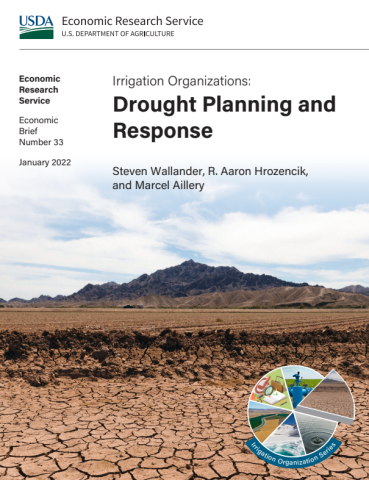
Drought can have a major impact on irrigated agricultural production. This report summarizes information from USDA’s 2019 Survey of Irrigation Organizations about an irrigation organizations’ role in drought planning and response.
Irrigation Organizations: Drought Planning and Response
Key Findings
- Large water delivery organizations (serving at least 10,000 acres) serve almost four-fifths of all farmland irrigated with off-farm water.
- Most organizations—with or without a drought plan—respond to droughts by proportionately reducing water deliveries to all users.
- Irrigation organizations rely heavily on snowpack reports and streamflow monitoring for short-run management decisions, and on long-range weather forecasts and reservoir reports for long-run management decisions.
- The most common water conservation investments made by irrigation organizations are flow-rate metering and canal lining.
Groundwater Management

This report summarizes information from the SIO about organizations that influence on-farm groundwater use. These organizations include groundwater districts, as well as some water delivery organizations that also directly influence on-farm groundwater use.
Irrigation Organizations: Groundwater Management
Key Findings
- In some regions, such as the U.S. High Plains, nearly all groundwater-fed irrigated acreage occurs within the service area of a groundwater organization. In other regions, such as the Southeast, a relatively small share of the groundwater-fed irrigated acreage is under the purview of a groundwater organization.
- The most commonly cited groundwater overdraft concerns among groundwater organizations are declining well capacity and diminishing water quality.
- Groundwater organizations report that the most important sources of information for long-term planning decisions are groundwater monitoring data, output from groundwater models, long-term weather forecasts, and reservoir storage reports.
Water Inflows and Outflows
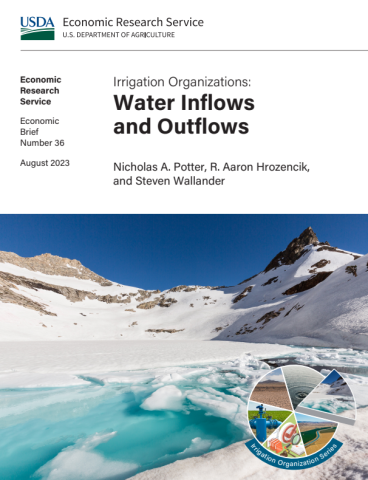
Irrigation water delivery organizations provide water for about 19 million irrigable acres, or approximately a third of all irrigated harvested cropland in the United States. This report examines these delivery organization inflows and outflows, and the extent of water transfers both within and across delivery organizations.
Irrigation Organizations: Water Inflows and Outflows
Key Findings
- In every U. S. region except the Southeast, direct diversions of surface water or water contracted from Federal sources make up more than 60 percent of water inflows to delivery organizations.
- Large delivery organizations (serving at least 10,000 agricultural acres) receive about half of their water supply from Federal water project storage facilities, while small delivery organizations (serving less than 1,000 acres) and medium-size delivery organizations (serving 1,000 to 10,000 acres) rely more on direct diversions from natural water bodies.
- Water marketing (leasing of rights to water by delivery organizations or between users within a delivery organization) is most common in the Pacific Region, where 17 percent of irrigation organizations engage in leasing for water that accounts for 9 percent of total regional inflows.
Water Measurement and Pricing

Water measurement and pricing are among the tools that irrigation organizations can use to conserve water resources. This report summarizes information about water measurement and pricing practices used by water delivery organizations.
Irrigation Organizations: Water Measurement and Pricing
Key Findings
- More than 20 percent of organizations reported not measuring water deliveries in all survey reporting regions except the Pacific region. Small irrigation water delivery organizations (serving less than 1,000 acres) were more likely to report not measuring water deliveries than larger organizations.
- About 45 percent of water delivery organizations priced water deliveries volumetrically, where users pay for water based on a per-unit price. Some of the organizations that used volumetric pricing also charged per-acre taxes or assessments, where users pay for water based on the number of acres irrigated with water delivered.
- Average volumetric water prices were highest in the Pacific region (equaling about $50 per acre-foot) where volumetric water pricing was common among irrigation water delivery organizations.
Organization Types and Governance

Irrigation organizations comprise a wide range of different legal and governance structures, which reflect water management needs in different contexts. This report summarizes differences in scale between different types of irrigation organizations, focusing on irrigable acres, farm size, assets, voting, and water marketing.
Irrigation Organizations: Organization Types and Governance
Key Findings
- Among organizations that reported conveyance infrastructure, unincorporated mutuals were the smallest type of irrigation organization. These organizations served an average of 519 acres and farms with an average size of 43 acres, whereas irrigation districts were the largest non-Federal irrigation organization, serving an average of 10,480 acres, with an average farm size of 118 acres.
- Financial reserves comprised 23 percent of total irrigation district assets and 7 and 8 percent of incorporated and unincorporated mutual organization assets, respectively.
- Irrigation organizations charged between $10 and $136 per acre-foot of water delivered to users and assessed between $26 and $51 per irrigated acre.