



Suggested citation for linking to this discussion:
U.S. Department of Agriculture, Economic Research Service. (2025, February 6). Farm sector income & finances: Highlights from the farm income forecast.
Farm Sector Profits Forecast To Increase in 2025
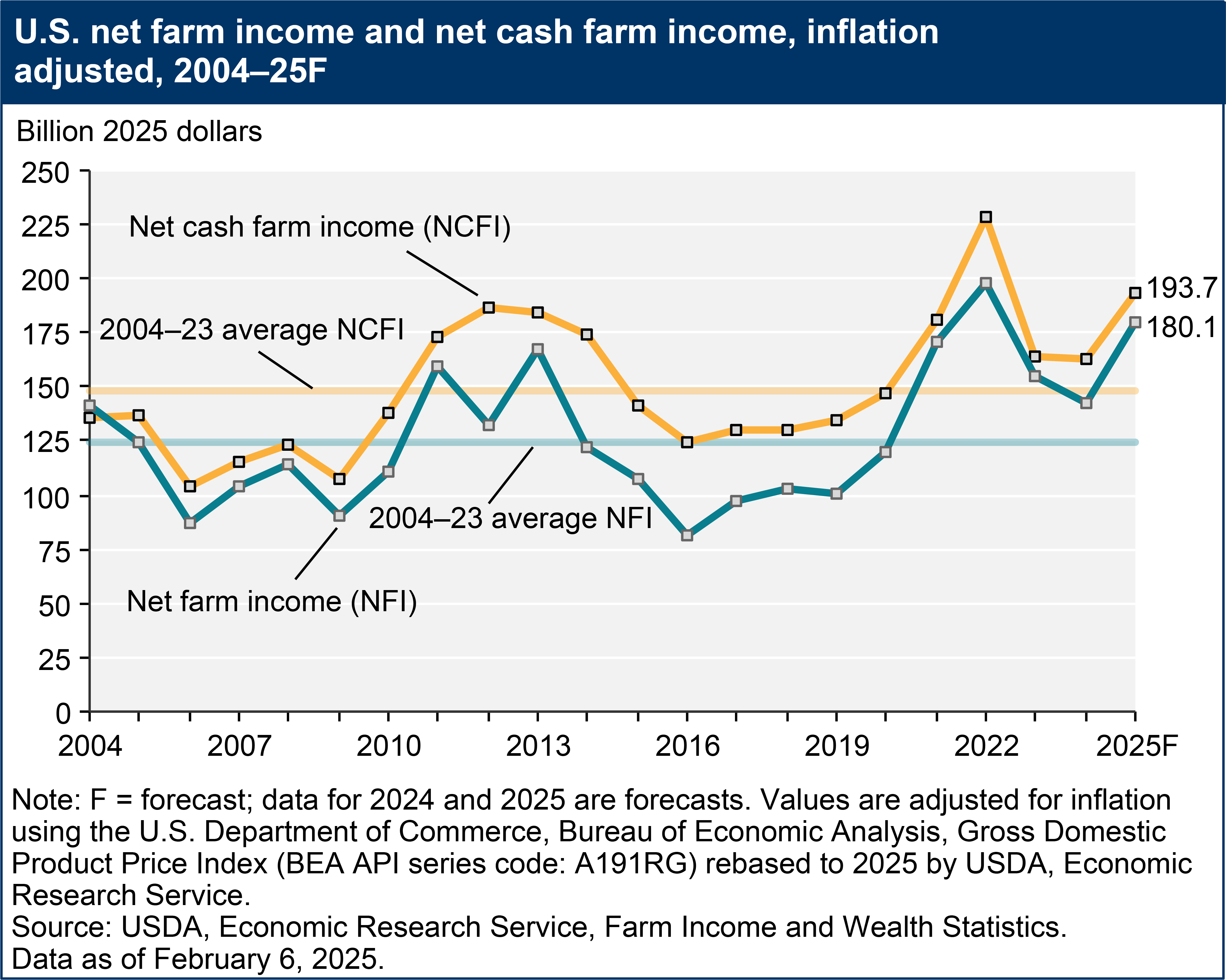
Net farm income, a broad measure of profits, is forecast at $180.1 billion for calendar year 2025, an increase of $41.0 billion (29.5 percent) relative to 2024 in nominal (not adjusted for inflation) dollars. This follows a forecast decrease for 2024 of $8.2 billion (5.6 percent) from 2023 to $139.1 billion. After adjusting for inflation, net farm income is forecast to increase by $37.7 billion (26.4 percent) in 2025 relative to 2024. With this expected increase, 2025 net farm income would be 44.8 percent above its 20-year average (2004–23) of $124.4 billion but 8.9 percent below 2022’s record high in inflation-adjusted dollars.
Net cash farm income is forecast at $193.7 billion for 2025, an increase of $34.5 billion (21.7 percent) relative to 2024 (not adjusted for inflation). From 2023 to 2024, net cash farm income is forecast to have remained relatively stable, increasing by $2.4 billion (1.6 percent) in nominal dollars but falling $1.4 billion (0.9 percent) after adjusting for inflation. When adjusted for inflation, 2025 net cash farm income is forecast to increase by $30.6 billion (18.8 percent) from 2024. If the forecast is realized, net cash farm income in 2025 would be 30.9 percent above its 2004–23 average of $148.0 billion but 15.2 percent below 2022’s record high. Net cash farm income encompasses cash receipts from farming as well as cash farm-related income (including Federal Government payments) minus cash expenses. It does not include noncash items (including changes in inventories, economic depreciation, and gross imputed rental income of operator dwellings) reflected in the net farm income measure.
Download chart image | Chart data
Cash receipts from the sale of agricultural commodities are forecast to decrease by $1.8 billion (0.3 percent) in nominal terms from 2024 to $515.0 billion in 2025. Total crop receipts are expected to decrease by $5.6 billion (2.3 percent) from 2024, led by lower receipts for soybeans and corn. In contrast, total animal/animal product receipts are expected to increase by $3.8 billion (1.4 percent), following increases in receipts for hogs, milk, and broilers.
Direct Government payments are forecast to rise by $33.1 billion (354.5 percent) from 2024 to $42.4 billion in 2025. This increase is expected largely because of supplemental and ad hoc disaster assistance to farmers and ranchers from the American Relief Act of 2025. Total production expenses, including operator dwelling expenses, are forecast to decrease by $2.5 billion (0.6 percent) to $450.4 billion in 2025. Feed, fertilizer (including lime and soil conditioners), and pesticide expenses are expected to see the largest dollar declines in 2025.
The average net cash farm income for farm businesses is forecast to increase 11.4 percent from 2024 to $128,900 per farm in 2025 in nominal terms. Farm businesses are farms with annual gross cash farm income (GCFI)—annual income before expenses—of at least $350,000 or operations with less than $350,000 in annual GCFI but that report farming as the operator's primary occupation. All nine USDA, Economic Research Service (ERS) Farm Resource Regions are expected to see average net cash farm income rise in 2025 relative to 2024, with farm businesses located in the Prairie Gateway region expected to see the largest increase. When grouped by commodity specialization, farm businesses specializing in animal/animal products are forecast to see higher average net cash farm income in 2025 while the outlook for those specializing in crops is mixed.
On the farm sector balance sheet, equity is expected to increase by $156.8 billion (4.3 percent) from 2024 to $3.83 trillion in 2025 in nominal terms. Farm sector assets are forecast to increase by $176.6 billion (4.2 percent) to $4.40 trillion in 2025 following an expected increase in the value of farm real estate assets. Farm sector debt is forecast to increase by $19.8 billion (3.7 percent) to $561.8 billion in 2025. Debt-to-asset levels for the sector are forecast to improve slightly from 12.84 percent in 2024 to 12.78 percent in 2025. Working capital is forecast to increase 3.9 percent in 2025 relative to 2024.
Read the full 2025 forecast for farm sector income or see data only at tables on farm income indicators.
Median Income of Farm Operator Households Forecast To Increase in 2024 and 2025
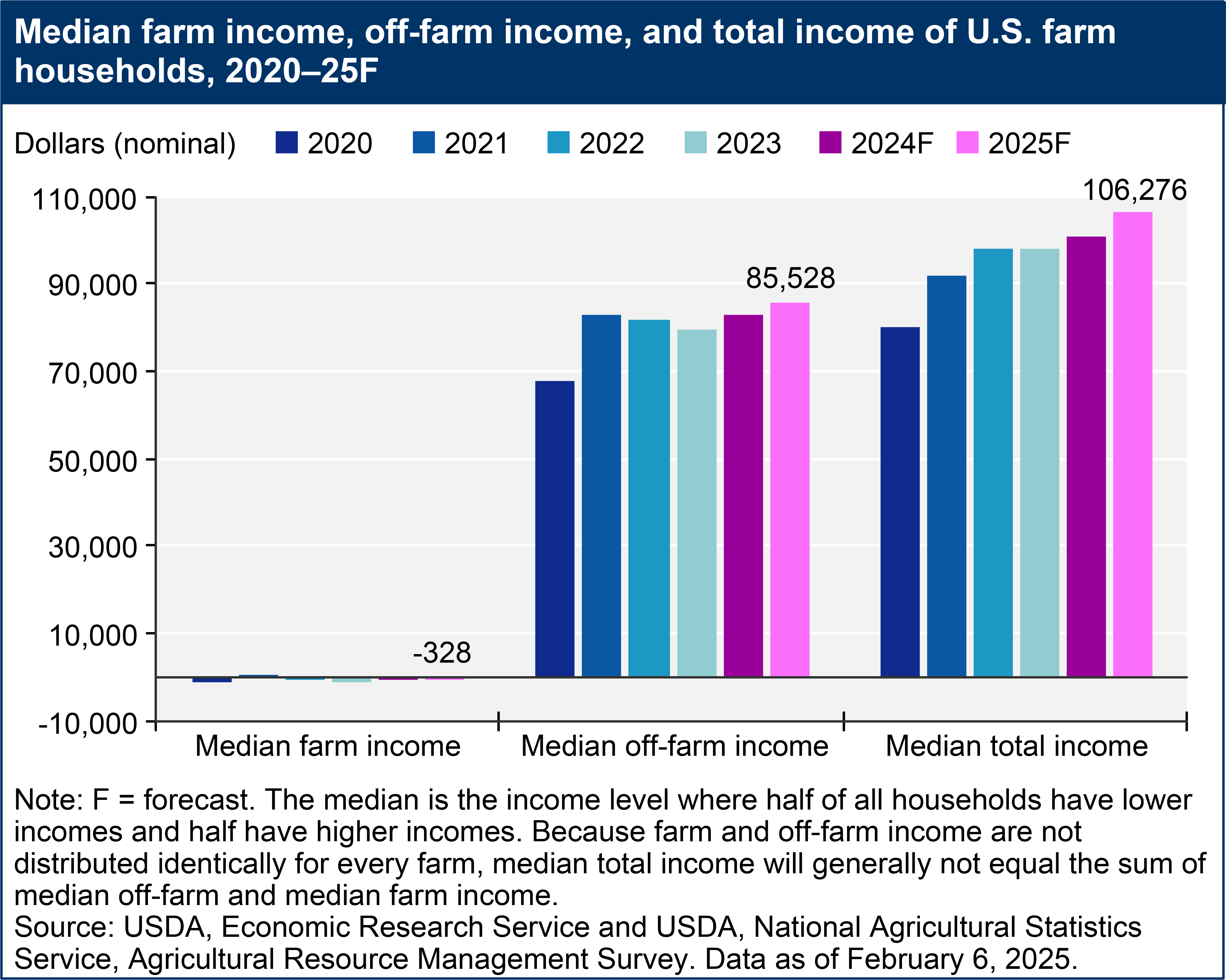
Median total farm household income is forecast at $100,840 in 2024, a 2.9 percent (0.4 percent after inflation) increase from 2023. It is forecast to reach $106,276 in 2025 with an increase of 5.4 percent (3.0 percent after inflation) relative to 2024.
Farm households typically receive income from farm and off-farm sources. Median farm income earned by farm households is forecast at -$651 in 2024 and is expected to reach -$328 in 2025. This follows a small forecast increase in farm income from 2023 to 2024. Many farm households primarily rely on off-farm income. Median off-farm income is forecast at $82,777 in 2024 after increasing 3.6 percent (1.1 percent after inflation) from 2023. In 2025 it is forecast to increase further by 3.3 percent (1.0 percent after inflation) to $85,528. Since farm and off-farm income are not distributed identically for every farm, median total income will generally not equal the sum of median off-farm and median farm income.
See the Farm Household Income and Characteristics data product tables for financial statistics of farm operator households.
Download chart image | Chart data
See also
- Farm Sector Income and Finances for a discussion of the full farm sector income forecast.
- Farm Household Well-being for a discussion of the farm household income forecast.
- Farm Income and Wealth Statistics for the complete farm income forecast data and full history of U.S. and State farm sector estimates.
- Charts and Maps of U.S. Farm Income and Finances Data for farm sector data visualizations.
- Farm Household Income and Characteristics for data related to farm household income and characteristics.
- ARMS Farm Financial and Crop Production Practices data that underpin the farm income forecast and estimates.