



National School Lunch Program
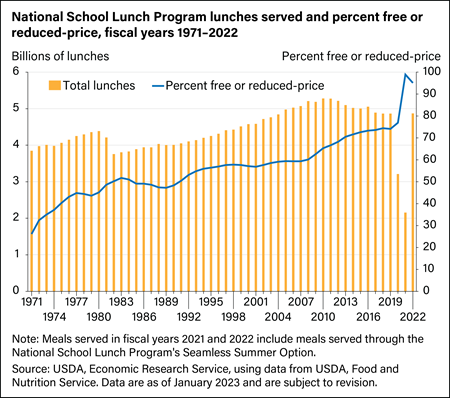
The National School Lunch Program (NSLP) provides low-cost or free lunches to children and operates in nearly 100,000 public and nonprofit private schools (grades Pre-Kindergarten–12) and residential child care institutions. In fiscal year (FY) 2019 (before the Coronavirus (COVID-19) pandemic), the program provided 4.9 billion lunches at a total cost of $14.2 billion.
USDA's Food and Nutrition Service (FNS) administers the NSLP and reimburses participating schools and residential child care institutions for the meals served to students. Any student in a participating school can get an NSLP lunch. Students from households with incomes:
- At or below 130 percent of the Federal poverty line can receive a free lunch.
- Between 130 and 185 percent of the Federal poverty line can receive a reduced-price lunch.
- Above 185 percent of the Federal poverty line can receive a low-cost, full-price lunch.
The onset of the pandemic in the second half of FY 2020 disrupted the provision of meals through the program by forcing schools to limit their operations. In response to these disruptions and to meet rising food needs during the pandemic, USDA issued waivers allowing for flexibilities in the implementation of the NSLP and expanded the scope and coverage of the program’s Seamless Summer Option (SSO). USDA also created the Pandemic Electronic Benefit Transfer (P-EBT) program to reimburse families with children eligible for free or reduced-price school meals for the value of school meals missed due to pandemic-related disruptions to in-person instruction at schools. To learn more about pandemic-era changes to the NSLP, please see:
- The Food and Nutrition Assistance Landscape: Fiscal Year 2020 Annual Report
- The Food and Nutrition Assistance Landscape: Fiscal Year 2021 Annual Report
- The Food and Nutrition Assistance Landscape: Fiscal Year 2022 Annual Report
- COVID-19 Working Paper: Filling the Pandemic Meal Gap: Disruptions to Child Nutrition Programs and Expansion of Free Meal Sites in the Early Months of the Pandemic
In FY 2020, the NSLP provided about 3.2 billion meals, 76.9 percent of which were served free or at a reduced price. This share was 2.8 percentage points more than in FY 2019. In FY 2021, the first full year of the pandemic, the program provided 2.2 billion meals, 98.9 percent of which were served free or at a reduced price. In FY 2022, the program provided 4.9 billion meals, about the same as in pre-pandemic years. In FY 2022, 95.1 percent of meals were served free or at a reduced price. The increase in the share of meals served free or at a reduced price in FY 2021 and FY 2022 is in part attributable to a USDA pandemic waiver allowing for meals to be provided free of charge to all students, regardless of their household’s income.
These waivers, along with most other Child Nutrition Program waivers, expired in the summer of 2022. The reintroduction of prices for some students may have increased hardship at a time when many households were still struggling with the economic consequences of the pandemic and its aftermath, such as rising inflation. A USDA, Economic Research Service (ERS) report found that nearly a third of households with school-aged children that paid for school meals in December 2022 reported that doing so made it difficult for them to pay for other usual expenses. To learn more, please see:
A USDA, ERS-sponsored 2010 study found that children from food-insecure and marginally food-secure households were more likely to eat school meals and received more of their food and nutrient intake from school meals than did other children. To learn more, please see:
Participation in USDA’s child nutrition programs, including NSLP, has been found to reduce food insecurity. To learn more about the impact of NSLP on food insecurity, please see:
Meals served through NSLP must meet Federal nutrition standards, which were updated in the Healthy, Hunger-Free Kids Act of 2010 (HHFKA) to more closely match the Federal Dietary Guidelines for Americans. The legislation also authorized an additional payment per meal (7 cents as of the 2021–22 school year) to schools when they demonstrated that they were serving meals that met the updated standards and established new regulations for meal prices charged to students not certified for free or reduced-price meals. To learn more about the new standards, their effect on children’s nutritional intake, and how schools strive to provide healthy and appealing meals that encourage student participation, please see:
- School Meals in Transition
- USDA School Meal Programs: How and Why the Cost of Food Purchases Varies Across Locales
- USDA School Meals Support Food Security and Good Nutrition
- Schoolchildren Consumed More Whole Grains Following Change in School Meal Standards
- Trends in U.S. Whole-Grain Intakes 1994–2018: The Roles of Age, Food Source, and School Food
In response to concerns about the role of the school meal environment in children's diets and other issues, the HHFKA also established updated nutrition standards for non-USDA foods sold in schools (often called "competitive foods") participating in USDA's school meal programs. The HHFKA also created the Community Eligibility Provision (CEP), an option that allows high-poverty schools to offer free meals to all students. To learn more about CEP, please see:
USDA also encourages school districts and their school food authorities—which administer the NSLP at the local level–to use locally produced foods in school meals and to use "farm-to-school" activities to spark students' interest in trying new foods. A USDA, FNS survey of school food authorities in the 2018–19 school year found that about two-thirds participated in farm-to-school activities. To learn more about the characteristics of school districts likely to serve local foods, please see:
All figures are based on data available as of January 2023 and are subject to revision.
For information on updates to the program during the COVID-19 pandemic, see FNS Responds to COVID-19.
Additional studies and information about program eligibility requirements, benefits, and application processes are available from the Food and Nutrition Service Child Nutrition Programs web page.
Download chart data in Excel format