



Documentation
Note: Updates to this data product are discontinued.
The geographic areas of nonmetro America exhibit a great deal of variation in economic and social characteristics. In addition to agricultural areas, nonmetro America includes sparsely populated mountainous regions, millions of acres of heavily forested areas, small towns, light manufacturing areas, tiny coastal hamlets, and the suburban fringes of growing metro areas. What we know about this heterogeneity is based largely on data for counties. This means that our understanding of nonmetro diversity comes from data on arbitrary political units.
Commuting zones (CZ's) and labor market areas (LMA's) were developed because county boundaries are not adequate confines for an area's economy. A local economy and its labor market are bounded not by the nearest county line, but by interrelationships between buyers and sellers of labor. If we are to understand the diversity of nonmetro America we need a geographic standard capturing variations in local economic and labor force activities. The central objective of CZ's and LMA's was to develop such a geographic unit that better captures the economic and social diversity of nonmetro areas.
For 1990, 741 commuting zones were delineated for all U.S. counties and county equivalents. These commuting zones were developed without regard to a minimum population threshold and are intended to be a spatial measure of the local labor market. Where necessary, the commuting zones were aggregated into 394 labor market areas that met the Bureau of the Census's criterion of a 100,000 population minimum. This was done to acquire a special 1990 Census Public Use Microdata Sample (PUMS-L) that identifies labor market areas in which individuals work. The commuting zones and labor market areas were also classified by the population of the largest city within each of them.
In 2000, there were 709 commuting zones delineated for the U.S. using the same methodology as was used in the previous decades. Labor market areas were not estimated for 2000, because many researchers found them to be too large and not as useful as the commuting zones.
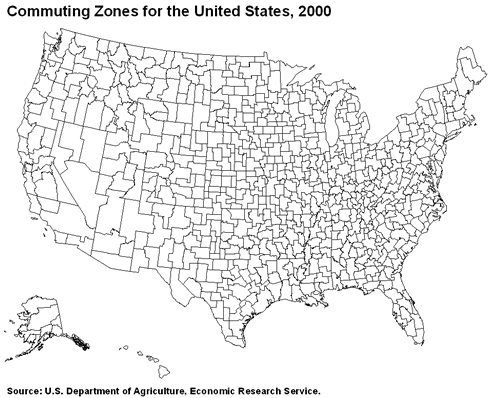
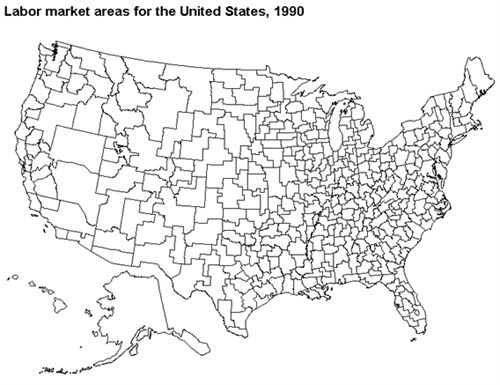
Nonmetro Commuting Zones and Labor Market Areas Classified by Size
- Small Town/Rural: Population of largest place in the commuting zone/labor market area was less than 5,000 in 1990.
- Small Urban Center: Population of largest place ranged from 5,000 to less than 20,000 in 1990.
- Large Urban Center: Population of largest place was at least 20,000 in 1990.
Metro Commuting Zones and Labor Market Areas
- Small Metro Center: Population of the largest MSA in the commuting zone/labor market area was less than 250,000 in 1990.
- Medium Metro Center: Population of largest MSA was at least 250,000 but less than 1,000,000 in 1990.
- Major Metro Center: Population of largest MSA was 1,000,000 or greater in 1990, or commuting zone/labor market area is part of a Consolidated Metropolitan Statistical Area.